
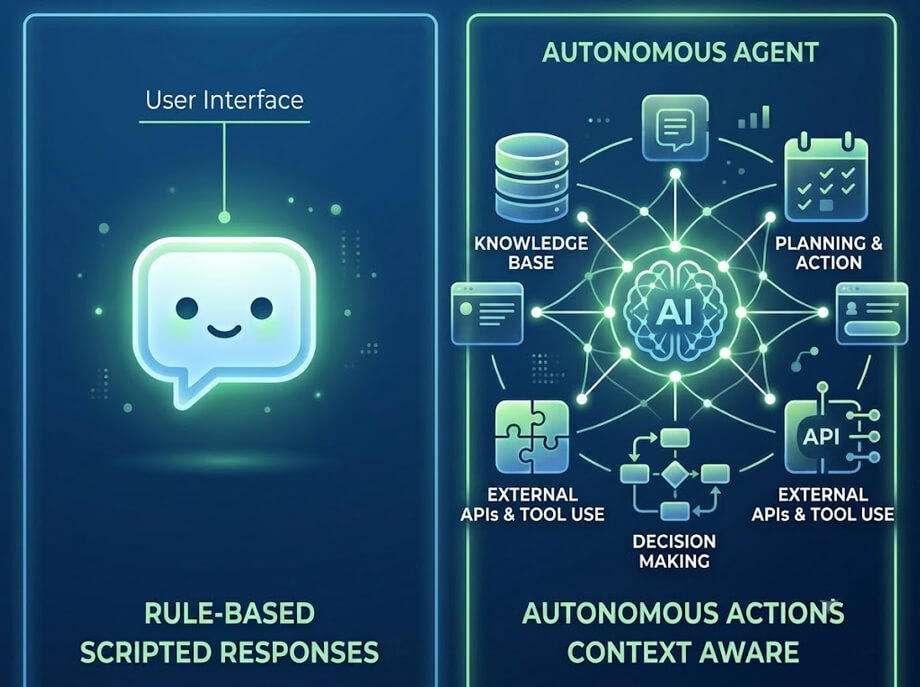
Organizations looking to implement automation often conflate “AI agents” with traditional “chatbots.” This confusion frequently leads to over-budgeting for simple conversational tools that fail to execute real work.
Before selecting a platform, understanding the functional boundaries between conversational interfaces and autonomous agents is critical to achieving measurable ROI.
Defining the Standard Chatbot
A chatbot operates primarily as a conversational layer designed to match incoming user phrases to a database of predefined answers. Rule-based bots follow rigid decision trees: if a user asks for “hours,” it returns a static text response. Any phrasing outside this predefined logic triggers an escalation or a generic error message.
While modern chat widgets integrate large language models to sound more human, their underlying function remains the same: retrieval-based responses. They do not execute background processes or interface with databases; they simply retrieve knowledge.
For simple FAQ automation, a standard chatbot is highly efficient and cost-effective. However, expecting a retrieval bot to manage end-to-end business operations is unrealistic.
The Capabilities of Autonomous AI Agents
An AI agent is designed around goals rather than prompts. Instead of simply generating replies, it evaluates the user’s objective and plans a sequence of actions across connected software tools to complete it.
Core characteristics of true agents include:
System-Level Integrations: Agents are connected to APIs, databases, CRM networks, and scheduling engines. They perform work inside your systems rather than just talking about them.
Branching Execution: When a user requests to reschedule an appointment, the agent checks real-time database calendars, applies rules, proposes options, and updates the scheduling table automatically.
Context Retention: Agents maintain memory of user profiles and past transactions across multiple sessions, eliminating repetitive user input.
Comparative Breakdown
| Operational Aspect | Chatbot | AI Agent |
|---|---|---|
| Primary Objective | Retrieve information | Execute workflows |
| Software Integrations | Minimal or none | Full CRM & Database Sync |
| Task Complexity | Single-step responses | Multi-step processes |
| Memory & Context | Session-bound only | Multi-session retention |
| Best Case Use | FAQ & Initial Triage | Booking, Syncing, Processing |
A Real-World Scenario: Scheduling Integration
If a customer messages: “Reschedule my Friday cleaning to next Thursday afternoon,” a chatbot will typically output a link to a booking page. The user still has to navigate the portal, find a slot, and manually re-enter their details.
In contrast, an AI agent checks the practice calendar, verifies open afternoon slots next Thursday, presents options, books the chosen slot, updates the CRM, and sends a confirmation text automatically.
One redirects the customer; the other resolves the task.
Identifying Your Organizational Need
Choose a chatbot if your goal is deflecting high-volume FAQ inquiries, providing basic business details, or establishing a low-cost contact widget.
Invest in an AI agent if you need to automate multi-step processes like appointment booking, data syncing, or customer ticketing without human intervention.
At IabepAI Agents, we help you identify the most efficient solution for your specific workflow. If a simple chatbot fits your needs, we build it. If your process requires a fully integrated agent, we engineer it from the ground up.