
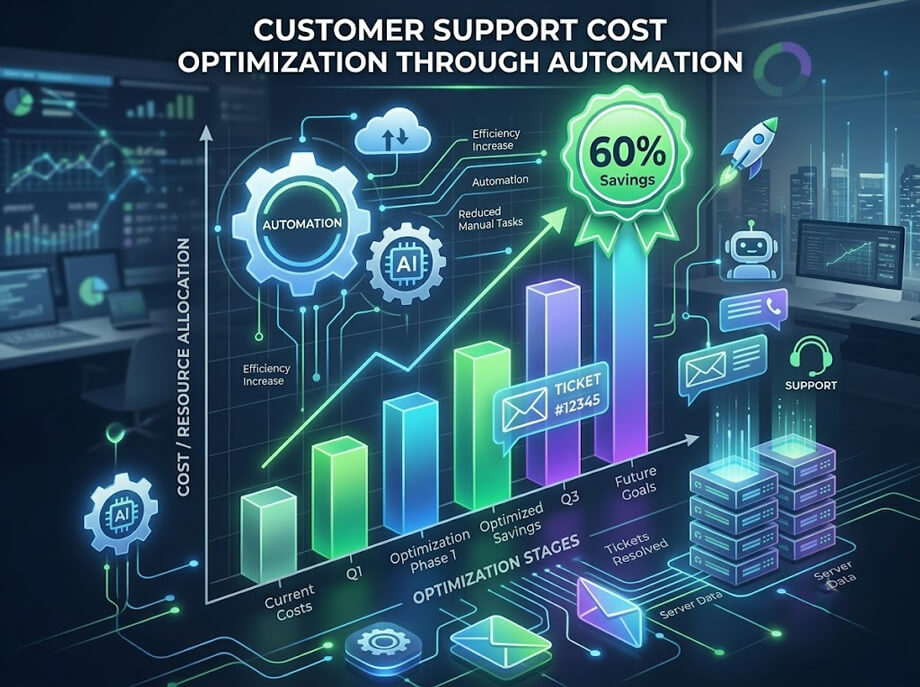
Achieving a 60% reduction in customer support overhead requires systematic planning and integration. Rather than replacing staff, this reduction comes from automating repetitive tasks and streamlining workflows.
Here is an analysis of how custom-engineered assistants achieve these metrics and what is required for deployment.
Addressing the High-Volume Support Queue
In most customer service operations, roughly 80% of incoming tickets consist of repetitive inquiries: order status tracking, password resets, basic billing questions, and standard troubleshooting. The remaining 20% represent complex cases requiring human judgment.
Wired directly into database platforms and CRMs, a custom assistant can resolve the repetitive 80% automatically, while routing complex escalations to your team with full context summaries.
Where the Savings Materialize
The cost reduction is achieved through several factors:
Managed Headcount Growth: Businesses can scale transaction volumes without linearly hiring more support representatives, lowering long-term operating costs.
Reduced Resolution Times: Because the assistant collects initial user details and performs initial triage, human agents resolve escalated tickets faster.
Minimized Ticket Re-Open Rates: Proper integration ensures queries are answered correctly the first time, reducing follow-up volume.
Continuous Support Coverage: Inbound inquiries are resolved 24/7 without overtime costs or night-shift differentials.
The Importance of Custom Systems Integration
To achieve meaningful cost reductions, assistants must be deeply integrated. Off-the-shelf chatbots are limited to displaying static articles. A custom assistant interfaces directly with your CRM, order platforms, and ticketing tools, allowing it to process refunds, update accounts, and edit entries according to your guidelines.
We build assistants that align with your operational processes. Schedule a consultation to evaluate your ticket queue and assess the cost reduction potential for your business.